Untitled
- ID
- cabfc73b-fb21-4644-8527-290828e320ad
- Created at
- 2026-06-29T01:11:08.242368+00:00
- Updated at
- 2026-06-29T01:11:08.242368+00:00
- Created by
- mart
- Source
- memory
- Reference
- Every Dollar Counts ← Back to Calculators Reset Inputs Share These Results Can…
- People
- —
- Location
-
longitude -71.89674011492961location 728 Rue McManamy Sherbrooke QC J1H 2M8 Canadalatitude 45.38946079262934
- Memory Status
- —
- Notifications
- —
- Linked Memories
- —
- Text
-
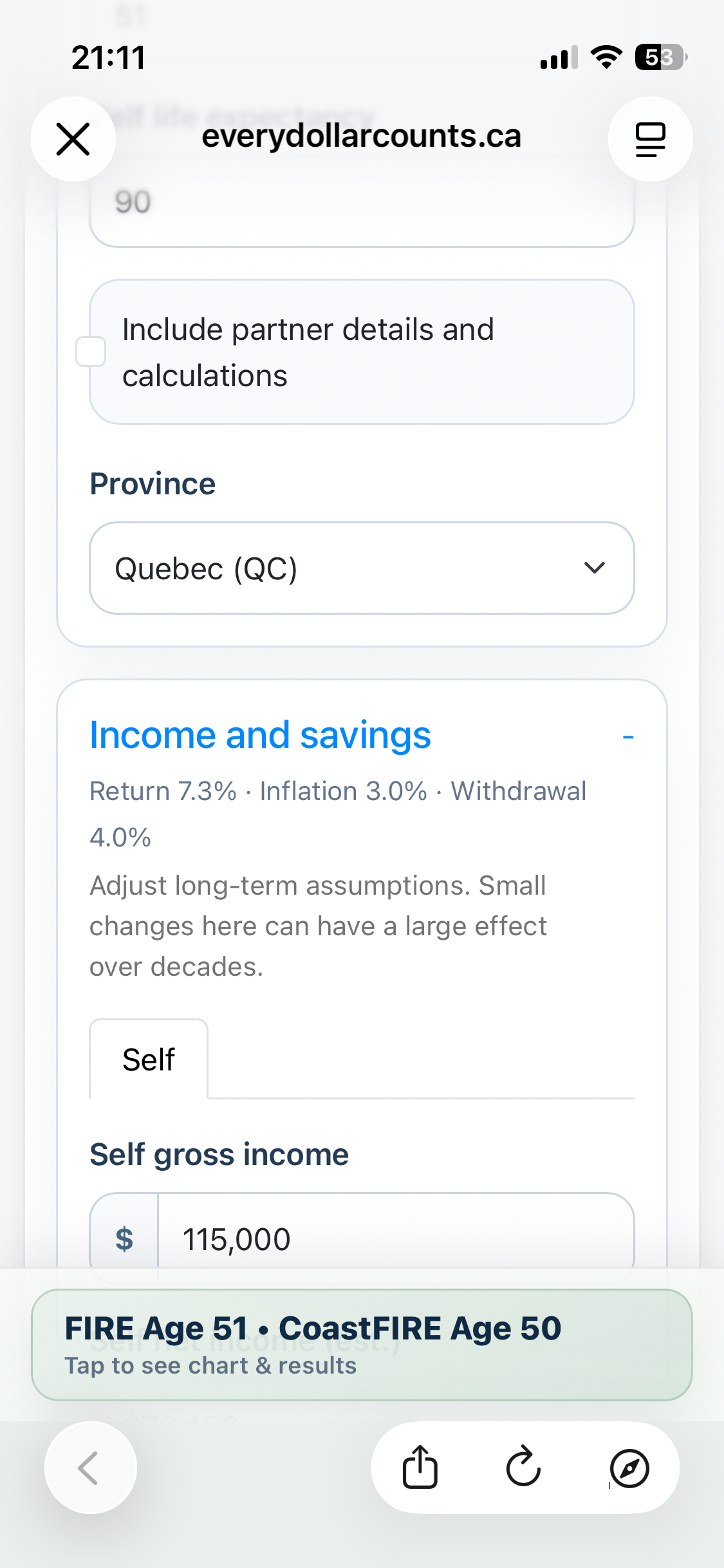
app Redditinput Every Dollar Counts ← Back to Calculators Reset Inputs Share These Results Canadian FIRE & CoastFIRE Calculator Estimate how long it will take to reach Financial Independence, Retire Early (FIRE) based on your savings, investment returns, and spending. Household Income Single-person estimate Add spouse or partner details when you want a household estimate. - Basics Set the core assumptions for your timeline and province. • Self Self current age Self retirement age Self life expectancy Include partner details and calculations Province Ontario (ON) Quebec (QC) British Columbia (BC) Alberta (AB) Manitoba (MB) Saskatchewan (SK) Nova Scotia (NS) New Brunswick (NB) Newfoundland (NL) Prince Edward Island (PE) Northwest Territories (NT) Nunavut (NU) Yukon (YT) Income and savings Return 7.3% · Inflation 3.0% · Withdrawal 4.0% Adjust long-term assumptions. Small changes here can have a large effect over decades. - Income and savings Use current income to estimate annual savings and taxes. • Self Self gross income $ 100000 Self net income (est.) $78,156 Household net (est.) $78,156 Adds both individual after-tax estimates together. Savings rate mode User specified rate User input amount Average saving rate among Canadians Super saver rate Expert recommended savings rate Self savings rate (%) Use each person's gross-income savings rate, before account splits are applied. Estimated yearly savings $86,250 Expected return mode User input return S&P 500 (nominal average) Total US Market (nominal average) Total Canadian Market (nominal average) Expected return (%) nominal Using a preset. Switch back to user input to edit this directly. Preset period Long-term (~50 yrs)Last 40 yrsLast 20 yrs Approx range: 9.5% – 10.5% (using midpoint 10.0%). Inflation mode User input inflation Canada CPI average, last 10 years Canada CPI average, last 20 years Canada CPI average, last 40 years Inflation rate (%) Used to grow income, savings targets, contribution limits, tax brackets, and retirement spending over time. Starting balances $610,000 total across TFSA and RRSP Choose how new savings get routed while you are still working. - Starting balances Where your portfolio stands today. • Self Self TFSA balance 0 Self RRSP balance 0 Self non-registered balance 0 Contribution strategy Custom contribution order Split your investments and contributions by account type. - Contribution strategy Choose how new savings get routed while you are still working. Strategy Priority rank (Null / 1 / 2 / 3 / 4) User input of % (savings rate + split) User input of total dollar savings Null means not used. Accounts with the same rank split evenly until capped. RRSP priority: 1 TFSA priority: 2 NonReg priority: 3 Savings are normalized automatically. Current effective split: TFSA 65.0%, RRSP 35.0%, FHSA 0.0%, NonReg 0.0%. 💡 Not sure if this is the best split for you? Compare TFSA vs RRSP RRSP refund auto-reinvestment When enabled, estimated RRSP tax refunds are added back into next year's savings, which can lead to larger projected portfolio balances. Retirement spending $50,000/year individual spending Adjust long-term assumptions. Small changes here can have a large effect over decades. + Retirement spending Controls the drawdown phase after retirement begins. • Self Self annual retirement spending $ 50000 Total household retirement spending $50,000 Combined total used by the simulation and retirement charts. Index with inflation Yes Include QPP / OAS / pension Yes QPP, OAS, and pension income QPP at 65 · OAS at 65 Government benefits can meaningfully reduce the portfolio needed in retirement. You can use defaults or enter your own estimates. + QPP, OAS, and pension income Control the retirement income assumptions that supplement portfolio withdrawals. • Self Self QPP monthly benefit Average QPP ($925.35/month) Max QPP ($1,507.67/month) Input your own value The selected QPP amount is treated as the estimated age-65 monthly value. The calculator adjusts it by QPP start age: minus 0.6% per month before age 65 down to age 60, or plus 0.7% per month for delays up to age 70. Self QPP start age 60 61 62 63 64 65 66 67 68 69 70 Self anticipated years in Canada after age 18 OAS is calculated as `years in Canada / 40 × max OAS`, then inflation-adjusted in retirement. OAS clawback is applied in retirement when taxable income exceeds $90,997. Benefits phase out at $148,451 for ages 65-74 and $154,196 for ages 75+. Self OAS start age 65 66 67 68 69 70 Choosing a later QPP/OAS start age delays when benefits begin, which can increase the portfolio needed to bridge the gap. Delayed QPP/OAS also increases the annual benefit amount, which can reduce the portfolio needed later in retirement. Current max OAS assumptions Ages 65-74 $743.05/month Ages 75+ $817.36/month Self employer pension Annual amount in today's dollars Percent of income at retirement Pension income is treated as fully taxable ordinary income and is inflation-adjusted in retirement. Annual pension amount in today's dollars $ 0 Windfalls and other income No cash flows added Add future windfalls or income streams. One-time amounts like inheritance or downsizing proceeds are treated as after-tax/non-taxable; recurring income like rental or business income is treated as taxable. + Windfalls and other income Add windfalls or income streams that could affect your retirement plan. One-time amounts, like inheritance or downsizing proceeds, are treated as after-tax/non-taxable. Recurring income, like rental or business income, is treated as taxable annual income. One-time windfalls are assumed to be after-tax or non-taxable amounts. For example, inheritance or net proceeds from selling a home. Recurring income is currently treated as taxable. No future cash flows added yet. Label / description Type One-time non-taxable income Recurring taxable annual income Owner Household / Joint User Spouse / Partner Amount $ 0 Start age Tax treatment Non-taxable / after-tax Add cash flow Withdrawal strategy Percentage split withdrawals - 4.0% SWR Choose how retirement withdrawals are determined each year. + Withdrawal strategy Choose how retirement withdrawals are determined each year. Strategy Spend 4% of portfolio at retirement, yearly Only withdraw the amount needed to hit the retirement spending target User input amount Safe withdrawal rate 4.0% Used for the portfolio-only FIRE benchmark, the QPP/OAS-adjusted FIRE curve, CoastFIRE, and the 4% withdrawal strategy. Account sourcing Percentage split by account Tax optimization: RRSP first, then TFSA Flat amounts by account Set the share of portfolio withdrawals to source from each account. RRSP % TFSA % Unregistered % Percent split totals 100.0%. Summary When can I FIRE? Age 51 (2030) When can I CoastFIRE? Age 50 (2029) Retirement success Portfolio lasts through plan Account balances Track beginning-of-year account balances while you adjust the plan. Reset Zoom The FIRE and CoastFIRE lines use the same QPP/OAS-adjusted retirement target. The FIRE curve can decline as retirement approaches QPP/OAS start age because fewer bridge years need to be funded by the portfolio. Yearly income in Retirement Shows inflation-adjusted earned income and adds QPP, OAS, and pension income once retirement begins. Each age shows a stacked cashflow bar for earned income, QPP, OAS, employer pension income, net portfolio withdrawals, and taxes paid. Taxes are shown on top of the stack, and net portfolio withdrawals reflect withdrawals after taxes. The dashed line shows the annual retirement spending target. Show inflation-adjusted dollars on charts Assumptions and methodology This section explains the official source data used in the calculator and how those inputs flow into the FIRE and CoastFIRE analysis. Source data used in this calculator • Federal and provincial tax rates: tax brackets, basic personal amounts, and related tax settings are based on the CRA 2026 individual income tax rate tables and payroll deduction tables. The current bundled tax file used by this calculator is the 2026 tax dataset. For 2026, the first federal bracket is taxed at 14% up to $58,523, followed by 20.5% up to $117,045, 26% up to $181,440, 29% up to $258,482, and 33% above that amount. CRA tax rates and income brackets • QPP estimates: the default QPP choices are seeded from the official Retraite Quebec monthly amount tables for average and maximum retirement pension values. This calculator uses your selected QPP start age, applies a 0.6% monthly reduction for starts before age 65 down to age 60, and a 0.7% monthly increase for delays after age 65 up to age 70. You can replace the base age-65 amount with your own estimate. QPP monthly payment amounts • OAS estimates: the default OAS amounts and recovery tax thresholds are based on the published Service Canada / Government of Canada OAS payment and clawback tables. Partial OAS is scaled using years lived in Canada after age 18. This calculator uses your selected OAS start age and applies the published 0.6% monthly increase for delays after age 65 up to age 70. OAS payment amounts and OAS recovery tax thresholds • RRIF conversion and withdrawals: this calculator assumes all RRSP assets are converted to a RRIF at age 71 and then applies the CRA minimum RRIF withdrawal factors each year after that. RRIF withdrawals are treated as eligible pension income for the federal pension income amount. RRSP options when you turn 71, RRIF prescribed factors, and pension income amount • Inflation presets: CPI-based inflation presets are derived from Bank of Canada inflation data. Preset return assumptions are planning assumptions built into the calculator rather than direct market forecasts. Bank of Canada inflation data How the FIRE and CoastFIRE analysis is calculated • Each year of the plan projects income, savings, account contributions, investment growth, taxes, and retirement spending from your current age through life expectancy. • Before retirement, savings are allocated across RRSP, TFSA, FHSA, and non-registered accounts using your selected contribution split, while registered-account room limits are enforced and any overflow can spill into non-registered savings. • At retirement, the model adds selected QPP, OAS, pension, and any part-time income assumptions, then compares that income against the retirement spending target to determine how much must come from the portfolio. • QPP and OAS are adjusted using the selected benefit start ages. This first pass applies early or delayed start factors, but it does not yet reduce QPP for fewer contribution years when someone leaves work earlier. • If you use the target gap withdrawal strategy, the calculator solves for the gross withdrawal needed to produce enough after-tax cash to meet the spending target. RRSP withdrawals are treated as taxable income, TFSA withdrawals are tax-free, and non-registered withdrawals include taxable capital gains treatment. • Starting at age 71, the calculator assumes the RRSP has been converted to a RRIF, stops new RRSP contributions, and enforces the CRA minimum RRIF withdrawal each year. Those RRIF withdrawals are included in taxable income and may qualify for the federal pension income amount. • Traditional FIRE number is the portfolio-only benchmark: annual retirement spending divided by the safe withdrawal rate, excluding QPP, OAS, and pension income. • QPP/OAS-adjusted FIRE number is age-dependent. It estimates the required portfolio at each tested retirement age by funding any bridge-period spending shortfall before benefits start, then discounting the post-benefit portfolio need back to that age. • CoastFIRE uses the same QPP/OAS-adjusted FIRE target, discounted back from the selected retirement age using the expected real return. This keeps FIRE and CoastFIRE internally consistent. Important notes This calculator is a planning tool. It simplifies real-world tax and retirement rules and does not replace personal financial, tax, or retirement advice. Results are sensitive to assumptions like savings rate, return, inflation, retirement age, withdrawal order, and benefit timing. Changing any of those inputs can materially change the FIRE date, CoastFIRE date, and whether the portfolio lasts through the plan. FIRE Age 51 • CoastFIRE Age 50 Tap to see chart & results © 2026 EveryDollarCounts Made in Canada About • Privacy • Contact Questions or corrections? [email protected] Educational info only - not financial advice. Connect with us: Logos are trademarks of their respective owners and are used for identification and comparison purposes only.
- Audio
- —
- AI Transcription
—
- AI Image Description
—
- AI Title
- —
- AI Summary
- —
- Tags
- —
- AI Status
- Pending
Images